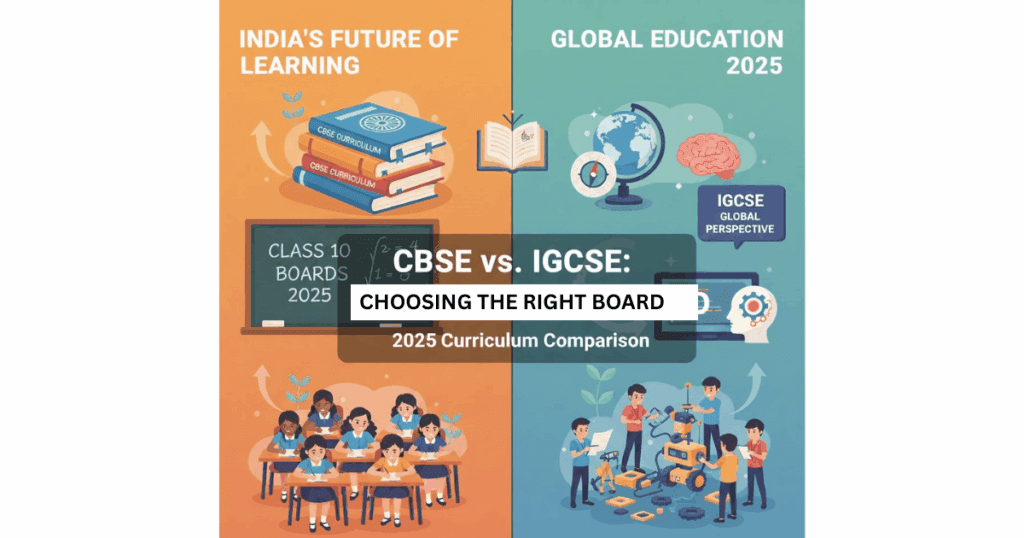
Parents today are increasingly comparing IGCSE and CBSE curricula to determine which will give their child a future-ready advantage. While CBSE focuses on structured academics and prepares students for Indian competitive exams, IGCSE nurtures creativity, critical thinking, and global exposure. By the end of this article, you’ll have a clear idea of which board aligns better with your child’s learning style and career aspirations.
Introduction
Choosing the right school board is one of the biggest decisions you’ll make for your child. With education evolving rapidly, especially in 2025, parents aren’t just looking for marks anymore—they want learning that prepares children for real-world problem-solving, technology-driven careers, and global opportunities.This shift has brought the debate of IGCSE vs CBSE into the spotlight. CBSE has been a trusted option in India for years, but the growing acceptance of the Cambridge IGCSE curriculum shows that today’s parents are prioritising skills, not just scores. So, which one should you choose? Let’s explore.
What Is IGCSE?
The International General Certificate of Secondary Education (IGCSE) is a globally recognised school curriculum and qualification offered by Cambridge Assessment International Education (CAIE) in the United Kingdom. It focuses on skill-based, inquiry-driven learning and offers a wide range of subjects across sciences, humanities, arts, and technology. IGCSE emphasises critical thinking, real-world application, and continuous assessment, making it a preferred choice for students planning to pursue higher education or careers in India and abroad.
Key Highlights of IGCSE
- Encourages inquiry-based and application-driven learning
- Offers 70+ subject choices, giving students room to explore
- Builds critical thinking, digital literacy, and research skills
- Uses varied assessments—projects, exams, oral tests, practicals
- Smooth transition to A-Levels, IB Diploma, and overseas universities
Best for: Children who enjoy hands-on learning, plan to study abroad, or want a curriculum suited for 21st-century careers.
What Is CBSE?
The Central Board of Secondary Education (CBSE) is a national-level education board in India that operates under the Ministry of Education. It provides a standardised curriculum based on NCERT textbooks and offers a structured academic framework from primary to senior secondary levels. CBSE focuses on developing a strong foundation in subjects like Mathematics and Science, and prepares students for major Indian competitive exams such as JEE and NEET. The board follows a uniform assessment pattern and is widely recognised across India, making it a popular choice for families seeking consistency, conceptual learning, and nationwide acceptance.
Key Highlights of CBSE
- Strong focus on Science and Mathematics
- Designed to support competitive exams like IIT-JEE and NEET
- Textbook-oriented teaching style
- Predictable exam pattern
- Highly convenient for students studying only within India
Best for: Children who like structured learning, perform well in exams, and plan to pursue competitive entrance tests in India.
IGCSE or CBSE: Key Differences at a Glance
| Feature | CBSE | IGCSE |
| Curriculum Focus | National, theory-based | Global, skill-based |
| Learning Approach | Textbook and lecture | Application & research-driven |
| Assessment | Annual board exams | Projects + coursework + external exams |
| Subjects | Limited choices | 70+ combinations |
| Recognition | Highly in India | Global acceptance |
| Ideal For | JEE/NEET aspirants | Global education & careers |
In a nutshell:
CBSE builds a solid foundation for Indian competitive exams through structured, exam-oriented learning, while IGCSE develops globally relevant skills and real-world application, preparing students for international education and career opportunities.
How the Syllabus Differs
CBSE Syllabus
The CBSE curriculum is designed around theoretical understanding and structured learning, with a strong emphasis on science and mathematics. Most concepts are taught through textbooks, and learning is often oriented toward scoring well in board exams and competitive tests like JEE or NEET. While the syllabus builds a solid academic foundation, it offers limited exposure to interdisciplinary projects, research-based activities, or real-life applications, which means students may spend more time memorising concepts than applying them.
IGCSE Syllabus
The IGCSE curriculum encourages students to explore concepts through real-world examples, experiments, and inquiry-based learning. Subjects are integrated with global themes, digital tools, and practical application, allowing students to understand why they are learning something, not just what. The syllabus is designed to promote critical thinking, problem-solving, communication, and creativity—skills that are essential for higher education and future careers.
Example:
- CBSE Mathematics focuses on formulas and direct problem-solving for exams.
- IGCSE Mathematics helps students analyse data, explore how math applies to business and finance, and make informed decisions using mathematical reasoning.
Teaching & Learning Style
| Aspect | CBSE | IGCSE |
| Teacher’s Role | Instructor | Learning guide/mentor |
| Classroom | Lecture-based | Inquiry-driven |
| Assignments | Homework focused | Projects, presentations, research |
| Skills Built | Memorization | Communication, creativity, reasoning |
Exam Patterns
CBSE Exams
- Single annual board exams (earlier term-based experiments have stopped)
- Marks-focused evaluation system
- Heavy emphasis on memorisation and theory-based questions
- High pressure during Class 10 and 12 board exams due to a one-shot assessment
- Limited internal assessments—final marks depend mainly on board exam performance
IGCSE Exams
- Grades from A to G* instead of marks
- Concept-based evaluation through multiple assessments, such as written papers, oral exams, coursework, and practical tests
- Reduced exam stress due to continuous internal evaluation
- Focuses on critical thinking, problem-solving, and application-based questions
- Students can choose subjects and appear for exams in different sessions (Feb–March / May–June), offering flexibility
Is IGCSE harder?
IGCSE is not necessarily harder—it is different. The curriculum focuses on understanding concepts, applying knowledge to real-life situations, and developing critical thinking rather than memorising facts. For students used to rote learning, this approach may feel challenging at first. However, many learners find IGCSE more engaging and beneficial in the long run because it builds analytical, problem-solving, and communication skills that are essential for higher education and global careers.
Recognition & Future Opportunities
CBSE
- Ideal for Indian universities and competitive engineering/medical exams
IGCSE
- Recognised globally by universities like Harvard, Oxford, Stanford, and more
- Supports careers in technology, design, AI, entrepreneurship, and international pathways
With jobs evolving rapidly, employers today value skills—not just certificates. This is where IGCSE clearly stands out.
Which Board Should You Choose in 2025?
Choose CBSE if your child:
- Choose CBSE if your child:
- Plans for JEE/NEET
- Prefers structured textbooks and clear instructions
- Performs well in exam-driven learning
Choose IGCSE if your child:
- May pursue higher studies abroad
- Enjoys projects, presentations, and hands-on learning
- Needs practical skills and global exposure
There’s no universal right answer—but if you want a curriculum aligned with modern careers and global opportunities, IGCSE is the stronger choice in 2025.
FAQs
1. Is IGCSE good for engineering?
Yes, IGCSE provides a strong foundation for engineering because it emphasises analytical thinking, problem-solving, and conceptual understanding, especially in subjects like Mathematics and Physics. Its inquiry-based approach helps students develop skills that engineering courses demand. However, students who plan to take Indian entrance exams such as JEE or NEET may choose to complement their IGCSE studies with additional preparation, as those exams follow specific national patterns. With the right academic pathway, IGCSE learners can successfully pursue engineering degrees in India and abroad.
2. Is IGCSE more expensive?
Yes, IGCSE is generally more expensive than many national boards because it uses international learning resources, external assessments, and specialised teacher training aligned with global education standards. The higher cost reflects the infrastructure and evaluation processes required to maintain an internationally recognised curriculum. However, fees vary by school, and parents should compare offerings, facilities, and long-term academic goals before making a decision.
3. Is IGCSE tough?
IGCSE is not inherently tough; it follows a different learning approach. Instead of memorising information, students are encouraged to understand concepts, think critically, and apply knowledge to real-life situations. For learners accustomed to rote learning, this shift may feel challenging at first. However, many students find IGCSE more engaging and rewarding because it builds long-term skills such as problem-solving, communication, and independent thinking.
4. Which board is best for studying abroad?
For studying abroad, boards like IGCSE, A-Levels, and the IB Diploma Programme are widely preferred because they are internationally recognised and align with global university admission requirements. These curricula focus on critical thinking, research skills, and subject flexibility, which match the expectations of universities overseas. However, students from CBSE can also study abroad with the right academic scores and required entrance qualifications. The choice depends on the student’s long-term goals and the countries they plan to apply to.